
What is AI - Part 2
From Automation to Creativity: Navigating the AI Hierarchy
Emroz Habib
3/24/20265 min read
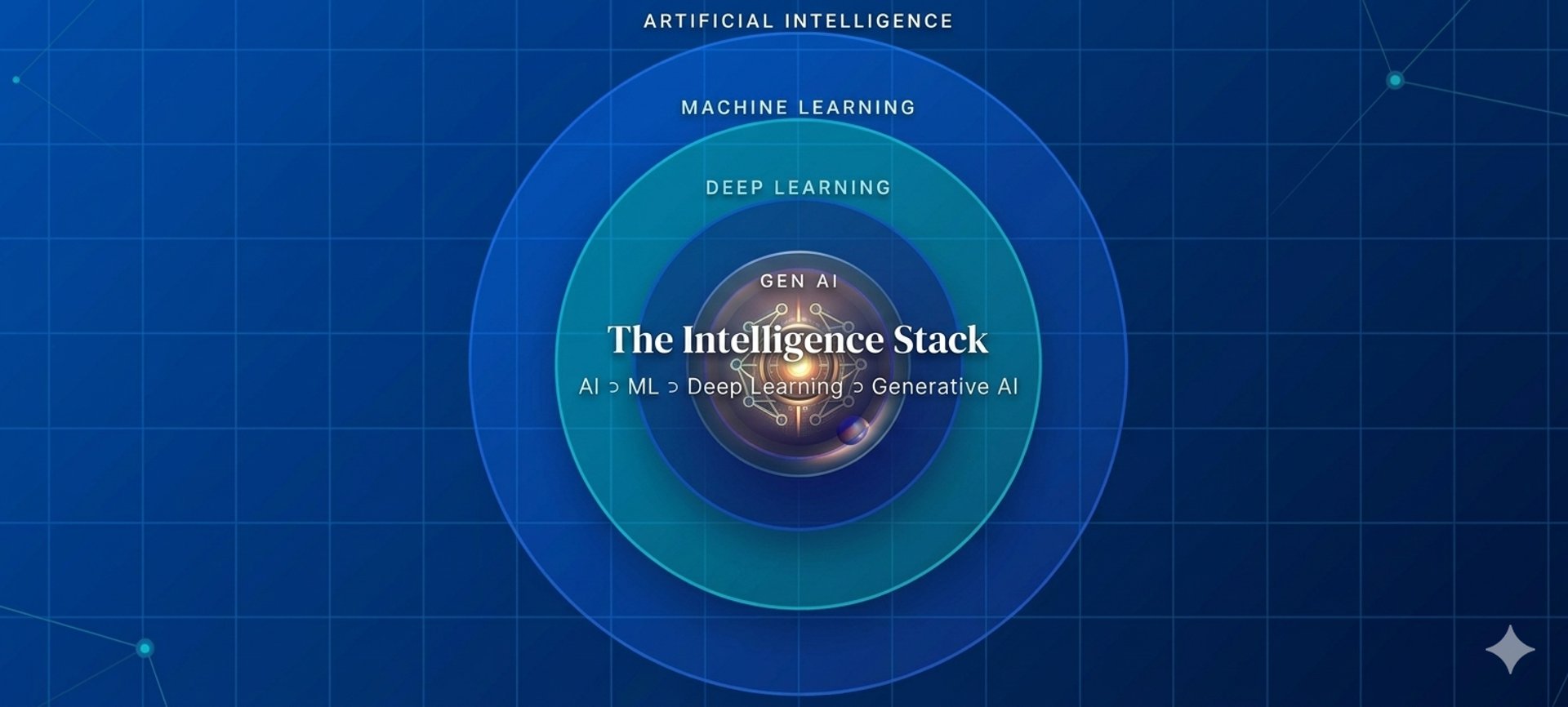
Artificial Intelligence is no longer just a futuristic concept whispered about in tech labs; it is the "digital teammate" helping us navigate our Monday mornings. However, as terms like Machine Learning, Deep Learning, and Generative AI dominate our feeds, they often get lumped together as synonyms.
To truly leverage these tools—whether for business strategy or personal productivity—we need to understand that they aren't competing ideas. They are layers of a hierarchy, each building upon the last to add depth, power, and possibility.
THE HIERARCHY
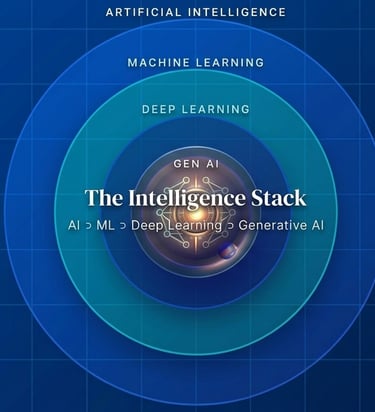
Four terms. One nested structure. Each concept lives inside the one before it — a continuum of intelligence and capability.
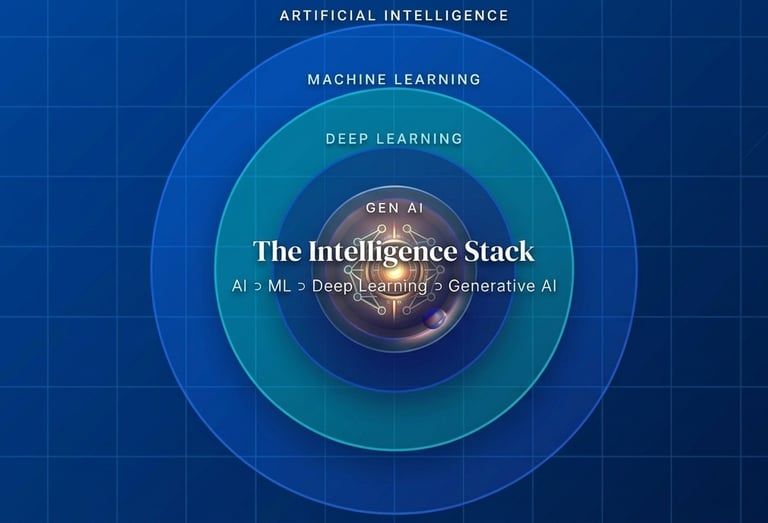
Layer 1 : AI : The Broadest Concept: Any System That Thinks
SCOPE : The widest umbrella — any system that mimics aspects of human intelligence.
Artificial intelligence is the widest umbrella. It refers to any system designed to mimic aspects of human intelligence — reasoning, problem solving, decision making, or understanding language.
AI includes rule-based systems like early chess programs that follow predefined logic, as well as systems that learn from data like recommendation engines. Today, most of what we interact with falls under narrow AI — voice assistants, fraud detection systems, or self-driving car perception modules.
These systems excel within a specific domain, but cannot transfer their skills to unrelated tasks. Brilliant specialists with no common sense.
A simple calculator, a thermostat, or a rule-based automation script is not AI. These systems don't learn or adapt — they just follow fixed instructions. What makes AI unique is that it gets better with experience. The more data it processes, the more accurately it can recognize patterns, make predictions, or tailor recommendations.
Example : Voice assistants, Fraud detection , Self-driving perception , Game-playing systems
Layer 2 : ML : Let the Data Do the Teaching
SCOPE : A subset of AI — learns patterns from data instead of following handcrafted rules.
Machine learning is a subset of AI focused on enabling machines to learn patterns from data, rather than following handcrafted rules. Instead of programming every decision step by step, we give an ML model examples — like thousands of emails labeled spam or not spam — and the system identifies patterns and improves over time without explicit instructions.
ML powers many tools we use daily: streaming recommendations, fraud alerts from your bank, and predictive text on your phone. Common algorithms include linear regression for predictions, decision trees for classification, and clustering for grouping similar data.
However, ML models struggle with massive amounts of unstructured data — photos, audio, natural language. To handle complexity at scale, we need something more powerful.
Example : Spam filtering, Recommendations, Fraud alerts, Predictive text
Layer 3 : DL : Layers Upon Layers of Intelligence
SCOPE : A specialized branch of ML — uses multi-layered neural networks for complex, high-dimensional data.
Deep learning is a specialized branch of machine learning that uses multi-layered neural networks to process complex data. Imagine trying to recognize a face in a photo. A traditional ML model might falter, but a deep learning network analyzes the image layer by layer — detecting edges, then shapes, then patterns — until it recognizes the face with high accuracy.
This layered approach has enabled breakthroughs across fields: computer vision, speech recognition, natural language understanding, and autonomous driving systems.
Deep learning relies on architectures like convolutional neural networks (CNNs) for images and recurrent neural networks (RNNs) for sequences like speech or text. And critically, it underpins the next major leap in AI.
Example : Computer vision, Speech recognition, Autonomous driving, Medical imaging
Layer 4 : Gen AI : From Analysis to Creation
SCOPE : The newest evolution — uses deep learning to create entirely new content.
Generative AI doesn't just analyze data — it creates new content. It can write essays, compose music, generate images, and produce videos. How does it work? Generative AI builds on deep learning models, especially transformers, which excel at understanding context.
These models are trained on billions of examples, and can generate outputs that feel coherent, relevant, and human-like. Generative AI is transforming marketing, entertainment, design, healthcare, and education.
But it also raises important concerns: bias, misinformation, and intellectual property issues — making responsible use not optional, but essential.
Example : Text generation, Image synthesis, Code generation, Music composition
WHEN TO USE WHAT
Understanding the hierarchy isn't just theoretical. It's practical. Businesses deciding whether to adopt AI need to ask the right questions:
// need
Simple automation or rule-based logic
→ AI (rule-based) is enough
→ Goals : Efficiency & Logic
// need
Predictions from historical or structured data
→ Machine Learning
→ Goals : Insights & Patterns
// need
Tackle problems involving images, audio, or speech
→ Deep Learning
→ Goals : Complexity at scale
// need
Generate content or scale creativity at speed
→ Generative AI
→ Goals : Innovation & Production
AI in the Real World: Beyond the Hype.
AI is often most effective when it is quietest. It’s the engine behind the "new normal," where data appears organized in seconds and workflows are streamlined without us noticing the "math" happening in the background.
Healthcare: AI models are now helping doctors read scans and detect diseases like cancer at earlier stages than ever before, improving outcomes through early intervention.
Sustainability: Farmers use AI to monitor crop health and optimize irrigation, boosting yields while conserving water.
Daily Life: From navigation apps rerouting us around traffic to streaming platforms comparing our habits against millions of users to find our next favorite show, AI is a constant partner.
RESPONSIBLE AI
AI decisions can affect real people. Approving a loan. Diagnosing a disease. Screening a job candidate.
⚖
Fairness
Avoiding bias and treating everyone equally. If a hiring AI is trained on biased historical data, it may unintentionally favor certain groups.
◻
Transparency
Explaining how decisions are made instead of hiding behind a black box. People deserve to understand why an AI made a decision about them.
◈
Privacy
Protecting personal data at every layer of the system. The power of AI depends on data — that data must be handled with respect.
◎
Accountability
Humans remain in control and responsible for outcomes. Technology helps — but human judgment and oversight must never be removed.
THE BOTTOM LINE
Not competing ideas.
Steps in a journey.
AI's evolution from rule-based systems to generative models reflects a shift from automation to creativity. Each layer — AI, ML, DL, and Gen AI — adds depth, power, and possibility.
As these technologies continue to converge, we'll see systems that not only think and learn, but also create, collaborate, and innovate. Yes, some roles will evolve. New opportunities will emerge in AI development, data analysis, robotics, ethical governance, and edge computing.
The goal isn't to replace people — it's to empower them to work smarter and adapt to a changing world. The question isn't whether AI will influence our world. It will.
The real question is: how will you choose to shape it?
Contact us
Whether you have a request, a query, or want to work with us, use the form below to get in touch with our team.


Location
19271 Bridle Path,
Hamel, MN 55340 , USA
Hours
I-V 9:00-18:00
VI - VII Closed
Contacts
Desktek.ai© 2026 Deshtek Inc.