What is AI - Part 1
From "What to Watch" to "How to Create": Understanding the AI Evolution
Emroz Habib
3/23/20263 min read

Have you ever opened a streaming app like Netflix or Spotify and felt like it was reading your mind? You finish a gritty crime drama, and suddenly, the perfect documentary or a hauntingly similar thriller is sitting right at the top of your feed.
This isn't a coincidence; it's Artificial Intelligence (AI).
By analyzing your viewing habits, the time of day you watch, and even how long you hover over a thumbnail, AI helps the platform curate a "digital storefront" just for you. This is just one way AI is transforming how we interact with technology. But what exactly is happening "under the hood"?
What is AI, Anyway?
At its core, Artificial Intelligence is the ability of a machine to mimic human intelligence. This doesn't just mean following a list of instructions—it means learning from experience, adapting to new information, and performing tasks that usually require a human brain.
Recognizing a friend's voice. Translating a menu in a foreign country. Suggesting the perfect sneaker trim. All AI. All powered by patterns hidden inside vast oceans of data.
"We are moving from a world where we tell computers exactly what to do, to a world where computers learn how to help us create a better future."
The Two Pillars: Rules vs. Patterns
To understand how we got here, we have to look at the two different ways researchers have tried to build "brains" out of code:
Symbolic AI (The Rule-Follower): Also known as "Good Old-Fashioned AI." These systems rely on explicit logic—think of a massive web of "if-then" statements.
Strength: Highly predictable and transparent.
Weakness: They struggle with the "messiness" of the real world. If a human hasn't programmed a specific rule for a situation, the AI gets stuck.
Machine Learning (The Pattern-Seeker): Instead of giving the computer rules, we give it examples. By processing massive amounts of data, the system figures out the patterns itself.
Strength: Excellent at complex tasks like facial recognition or movie recommendations.
Weakness: These models can be "black boxes"—sometimes it’s hard to explain exactly why the AI made a certain decision.
The Future is Hybrid: Today's researchers are combining both approaches—building systems that are adaptable like Machine Learning, yet explainable like Symbolic AI. The best of both worlds.
Not All AI Is Created Equal
We generally categorize artificial intelligence into three distinct levels, each representing a leap in capability—and ambition.
Not all AI is created equal. We generally categorize AI into three distinct levels:
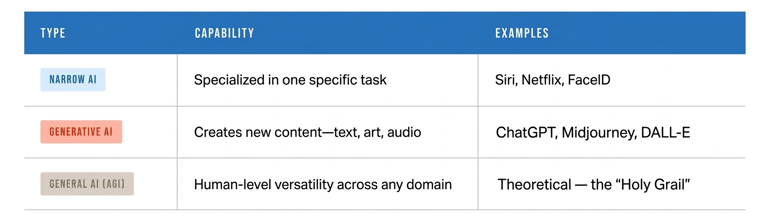
1. Narrow AI — The Specialist
This is the AI we use every day. It's brilliant at what it does, but it lacks common sense. An AI that diagnoses a medical condition with 99% accuracy can't write a poem or drive a car. It stays in its lane—and it stays in it very, very well.
VOICE ASSISTANTS, RECOMMENDATIONS, BIOMETRICS
2. Generative AI — The Creator
This is the breakthrough that has captured the world's imagination. Unlike traditional AI that just classifies data, Generative AI creates. LLMs like GPT understand context to write essays, code, and poetry. Diffusion models take random digital "noise" and refine it into photorealistic images from a simple text prompt.
LLMS, DIFFUSION MODELS, TEXT TO IMAGE, CODE GENERATION
3. General AI (AGI) — The Future Goal
AGI is the "leap forward." It would be an AI that doesn't need to be retrained to learn a new skill—one that could design a building, learn the cello, and solve a physics problem all using the same underlying "mind." Still theoretical, but some experts believe we may see its emergence within the next decade.
THEORETICAL, MULTI-DOMAIN, THE HOLY GRAIL
The Bottom Line
Whether it's helping you pick out your Friday night movie or next pair of shoes or assisting doctors in life-saving diagnostics, AI is becoming an invisible but essential layer in our lives.
The journey from rigid rule-followers to creative, context-aware machines is one of the most remarkable stories of our era. And we're still in the early chapters.
The question is no longer will AI change the world—it already has. The question is whether we understand it well enough to help shape what comes next.
Contact us
Whether you have a request, a query, or want to work with us, use the form below to get in touch with our team.


Location
19271 Bridle Path,
Hamel, MN 55340 , USA
Hours
I-V 9:00-18:00
VI - VII Closed
Contacts
Desktek.ai© 2026 Deshtek Inc.